





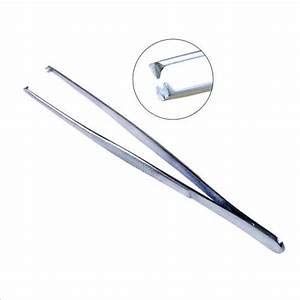
DESCRIPTION
In the world of dentistry, tooth extraction forceps are the ultimate “precision levers.” While they might look like something from a hardware store, they are highly specialized instruments designed to grasp, luxate (loosen), and remove teeth from their bony sockets with minimal trauma.
Anatomy of a Forceps
Every pair of forceps generally consists of three main parts:
-
The Beaks: The “business end” that grips the tooth. These are designed to fit the specific anatomy of the tooth’s root or crown.
-
The Hinge: The joint that connects the handles to the beaks, transferring the pressure.
-
The Handles: The part the dentist holds. They are often serrated or textured to ensure a firm grip, even when gloves are wet.
Design Logic: Form Meets Function
Forceps aren’t “one size fits all.” Their design depends entirely on where they are going in the mouth:
1. Maxillary (Upper) Forceps
Since upper teeth are usually accessed from a straight or slightly angled approach, these forceps typically have:
-
Straight handles or a slight “S” curve to bypass the lower lip.
-
Beaks that are parallel to the handles.
2. Mandibular (Lower) Forceps
To reach the lower jaw while keeping the dentist’s hand out of the line of sight, these feature:
-
90-degree bends at the hinge.
-
Beaks that are set at a right angle to the handles.
3. Anatomical Specificity
-
Incisor/Cane Forceps: Have narrow, straight beaks for single-rooted teeth.
-
Molar Forceps: Often feature a “point” or “horn” on the beak. This point is designed to fit perfectly into the furcation (the space where the roots branch out) to provide a more secure grip.
-
Cowhorn Forceps: Shaped like a literal pair of horns; these are used specifically to “pump” into the furcation of lower molars to lift them out.
The Golden Rule of Use
It’s a common misconception that teeth are “pulled.” In reality, forceps are used to apply controlled pressure (buccal, lingual, and rotational) to expand the bone socket and sever the periodontal ligament. The tooth is then “lifted” out rather than yanked.



Reviews
There are no reviews yet.