





DESCRIPTION
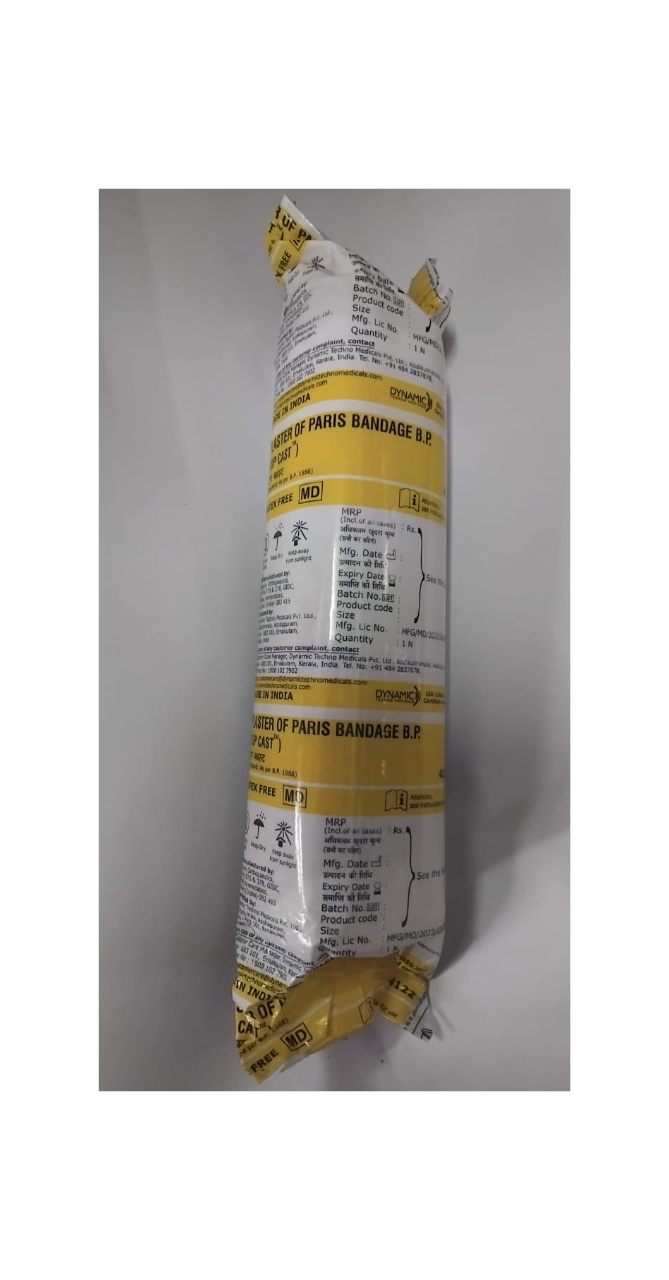
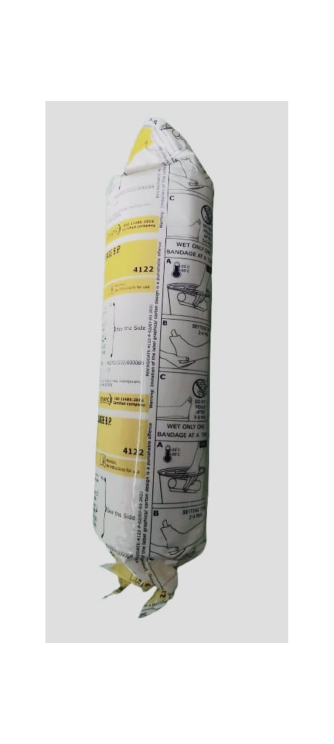
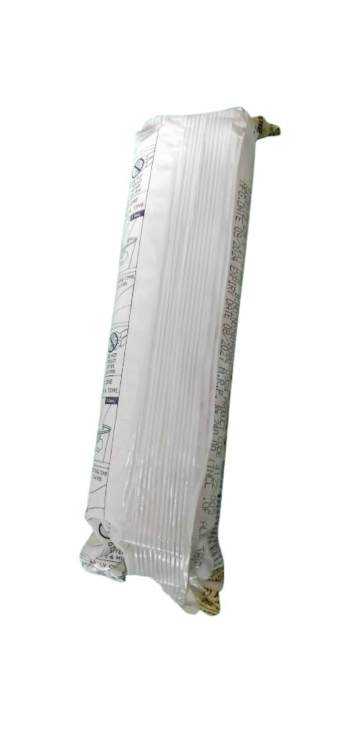
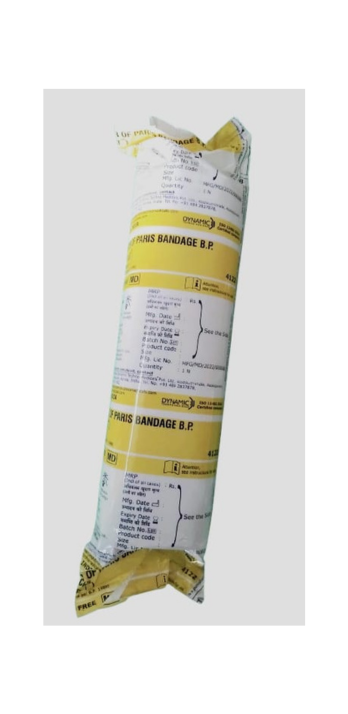
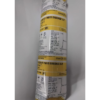
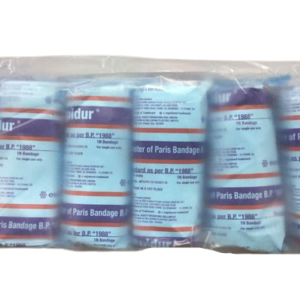
A Plaster of Paris (P.O.P.) Bandage B.P. (British Pharmacopoeia) is a specialized medical dressing used primarily in orthopedics to create rigid casts for immobilizing fractures, diseased joints, or corrected deformities.
Here is a detailed breakdown of its description according to standard medical specifications:
1. Composition
The bandage consists of a cotton gauze substrate (usually a leno-weave fabric) that is evenly impregnated with high-quality Calcium Sulfate Hemihydrate ($CaSO_{4} \cdot \frac{1}{2}H_{2}O$).
-
The Matrix: The plaster is often held to the fabric by a binder (like methylcellulose or starch) to prevent the powder from shedding before use.
-
The Reaction: When water is added, it undergoes an exothermic reaction to become Calcium Sulfate Dihydrate (Gypsum):
$$CaSO_{4} \cdot \frac{1}{2}H_{2}O + 1\frac{1}{2}H_{2}O \rightarrow CaSO_{4} \cdot 2H_{2}O + \text{Heat}$$
2. Physical Characteristics
-
Fabric: The gauze used is typically “Leno-weave” cotton, which provides better stability and prevents the threads from shifting, ensuring the plaster stays locked in the mesh.
-
Form: It is supplied in rolls of varying widths (e.g., 5cm, 10cm, 15cm, and 20cm).
-
Texture: The bandage should feel uniform and dry. It should not be gritty or have large lumps of plaster that could cause pressure sores once hardened.
Key Properties
-
Exothermic Reaction: As it sets, the bandage generates a noticeable but safe amount of heat.
-
Permeability: Once dry, the cast is slightly porous, allowing for some “breathing,” though it is not waterproof.
-
Mouldability: It is highly prized for its “creamy” texture when wet, allowing the clinician to mold it precisely to the patient’s anatomy.
Important Note: P.O.P. bandages are sensitive to moisture. They must be stored in a cool, dry place in their original airtight packaging to prevent “dead” spots where the plaster has already partially reacted with atmospheric humidity
-

Reviews
There are no reviews yet.